


Listen Live:
Saturday’s: 9AM
Fox Sports Ventura
1590 AM/97.9 FM KVTA
Sunday’s: 6:30AM
K-EARTH 101 FM
Listen Live:
Saturday’s: 9AM
Fox Sports Ventura
1590 AM/97.9 FM KVTA
Sunday’s: 6:30AM
K-EARTH 101 FM
A Look Into the Markets

Mortgage rates improved sharply this week after recently touching the highest levels of 2026. The improvement was meaningful, especially with the 10-year Treasury yield moving back nicely beneath 5.20% for the first time in several weeks. Let’s discuss what happened and take a look at next week’s action.
“To everything (turn, turn, turn), There is a season (turn, turn, turn) And a time to every purpose under heaven” Turn Turn Turn by the Byrds.
CPI Sparks a Volatile Reaction
The biggest market mover of the week came Tuesday with the release of the Consumer Price Index. This was a highly anticipated inflation reading because markets were looking for clues on whether the Fed may hike rates again in October or whether the Fed may be close to finished raising rates altogether. The report was inline to hotter than expected. The headline CPI, which is energy driven, met hot expectations on both a month-over-month and year-over-year basis. Core CPI, which strips out food and energy, also came in hotter than expected, missing estimates by one-tenth.
The initial bond market reaction was fast and sharp, with the 10-year Treasury yield spiking from 5.19% to over 5.30% shortly after the report. But then something important happened: yields reversed course and finished the day right back near 5.19%.
So, what happened?
There appear to be a couple of tug-of-wars taking place in the bond market. On one hand, hotter inflation keeps pressure on the Fed and the idea that inflation will remain above target for longer than expected. It also raises the possibility that the Fed may need to keep rates higher for longer, and maybe hike more than previously expected.
On the other hand, higher yields have been and continue to attract bond buyers and investors. Over the last couple of weeks, we watched the 10-year Treasury struggle to move above the 5.35% area. Each time yields pressed toward that level, buyers seemed to step in. That matters because bond buying helps push yields lower.
We may also be seeing a more normal market relationship return, where stocks can move lower while bonds improve and rates move lower. That is a typical relationship in the markets, but it has not been something we have seen consistently in recent years.
Simply put: bad news for stocks may finally be starting to become better news for bonds again.
Fed Speak Still Dovish
Outside of the inflation reading, Fed speak remained somewhat dovish this week. New York Fed President John Williams suggested the Fed may only need to hike one more time and possibly not at all next year. That was a bold comment, especially coming just one day before a hotter-than-expected CPI report.
The takeaway is that even though inflation remains too high, some Fed officials may believe policy is already restrictive enough to keep slowing the economy over time. That does not mean the Fed is ready to cut rates. It simply means the bar for multiple additional rate hikes may be getting higher.
For the bond market, that matters. If investors believe the Fed is near the end of its hiking cycle, longer-term rates can begin to stabilize, even when individual inflation reports come in hotter than expected. Note: the chance of a rate hike in October remains low at 25% despite the hot CPI report.
5.20%
A key level we are watching is 5.20% on the 10-year Treasury. For the last few weeks, the 10-year pressed up against the 5.35% area, which marked the highest yield level in years. But instead of breaking meaningfully higher, yields backed away and moved under 5.20% in the middle of the week. That is a welcome sign.
The 5.20% level had previously helped prevent yields from moving higher on the way up. Now that yields are beneath it, we want to see if that area can hold as resistance, capping a rise in rates.
If the 10-year Treasury can remain below 5.20%, it could help open the door for a move closer to 5.00%. That would be welcome news for mortgage rates.
30-Year Mortgage Rates and 10-Year Note
30-Year Fixed Mortgage Rate (Freddie Mac daily average, October 15, 2026)
10-Year Treasury Note Yield (daily close, October 15, 2026)
Change Year-over-Year: up from ~4.05% on October 8, 2025
Chart: Fannie Mae 30-Year 6.0% Coupon (Friday, October 16, 2026)
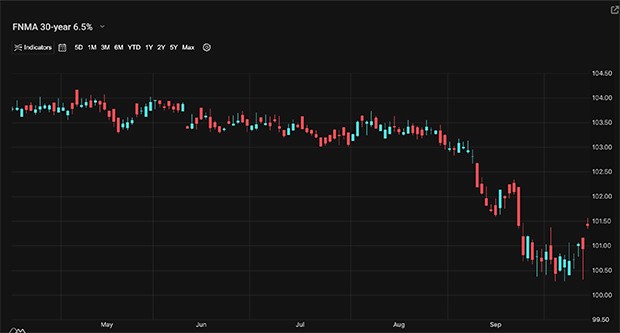
Each candle represents one day of trading. As mortgage bonds prices move higher, rates move lower. The longer-term chart on the lower right shows prices rebounding sharply from their 2026 lows.
Looking Ahead
Next week will be a lighter news week in the run-up to the next Fed meeting, which takes place October 27 & 28. With the Fed still weighing sticky inflation against signs that higher rates are starting to bite, markets will remain sensitive to anything that shifts expectations for another rate hike.
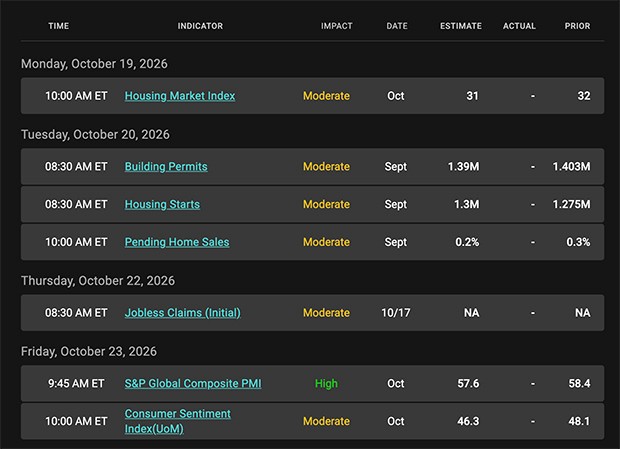
Housing will be in focus with reports on builder confidence, housing starts, building permits, and pending home sales. With mortgage rates near the highest levels of the year, signs of further slowing housing activity could help bonds improve.
The labor market is not as important to the Fed as inflation right now, but it is still something to keep on your radar. We will get initial jobless claims on Thursday, and claims are currently running near a four-decade low. A meaningful move higher would suggest the labor market is softening, while another very low reading would show employers are still reluctant to lay off workers.
Economic Calendar for the Week of October 19th – 23rd
The material provided is for informational and educational purposes only and should not be construed as investment and/or mortgage advice. Although the material is deemed to be accurate and reliable, we do not make any representations as to its accuracy or completeness and as a result, there is no guarantee it is without errors.
As your mortgage professional, I am committed to keeping you updated on the economic events that impact interest rates and how they may affect you.

Next Broadcasts
Fox Sport Ventura 1590 AM & 97.9 FM KVTA FM
Your Real Estate Life with Mike Harris
Saturday Oct 24, 2026 at
9:00 am

CalBRE #01870497 | WA #CL-3189
CA: DRE #00991234
CO: MLO-100524628
MT: MLO-233410
TX: SML MLO-233410
WA: MLO-233410
DSCR in 46 States
(not ND, NV, SD, VT)

